By Form and Fly
For the last two decades, the rules of the digital road were simple. You identified keywords, you wrote content, you built backlinks, and you prayed to the Google gods for a spot on the first page of the “10 blue links.”
That era is over.
As we move deeper into 2026, we aren’t just optimizing for search engines anymore; we are optimizing for Answer Engines and Generative Engines. The user journey has fractured. It’s no longer just a straight line from Query $\rightarrow$ Click $\rightarrow$ Website. Now, it’s Query $\rightarrow$ AI Synthesis $\rightarrow$ Answer.
At Form and Fly, we’ve seen this shift coming. We know that businesses clinging solely to traditional SEO strategies are seeing their click-through rates (CTR) decline, not because their rankings dropped, but because the interface of the internet has changed.
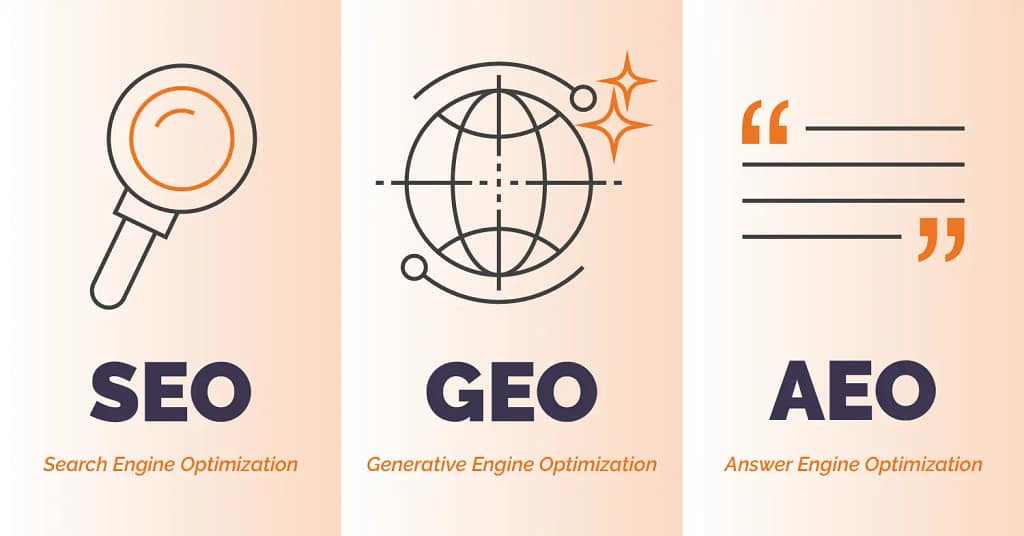
This guide is your blueprint for the new reality. We’re going to break down the new “Trinity of Search”—SEO, AEO, and GEO—and show you exactly how to future-proof your digital presence.
Part 1: The Great Fragmentation
From Keywords to Conversations
To understand why your strategy needs to change, you have to look at how behavior has changed.
In the old model (SEO), a user typed “best running shoes” into Google. They got a list of links. They opened five tabs, compared prices, read reviews, and made a choice. The search engine was a gateway.
In the new model (AEO and GEO), a user asks Gemini, ChatGPT, or Perplexity: “I’m training for a marathon on pavement and have flat feet. What are the best running shoes for me under $150?”
The AI doesn’t just give links; it gives an answer. It synthesizes reviews, checks specs, and presents a recommendation. If your brand is mentioned in that recommendation, you win. If you’re just a link at the bottom of the page, you are invisible.
This is the difference between indexing (SEO) and synthesis (GEO).
Part 2: The Foundation—SEO (Search Engine Optimization)
The Plumbing of the Internet
Before we get excited about the new acronyms, let’s be clear: SEO is not dead. It has simply evolved from being the whole strategy to being the foundation of the strategy.
Think of SEO as the plumbing. Without technical SEO, the AI crawlers cannot find your content to learn from it. If your site is slow, broken, or unstructured, no amount of AI optimization will save you.
The Role of SEO in 2026:
- Crawlability: Ensuring bots (both Googlebot and AI crawlers like GPTBot) can access your site.
- Site Speed: Core Web Vitals still matter for user retention.
- Keywords: Still relevant, but now they function as “topic anchors” rather than magic spells.
The Form and Fly Takeaway: Don’t abandon your SEO agency. But if your agency only talks about backlinks and keyword density, run. You need a technical foundation that supports the next two layers.
Part 3: AEO (Answer Engine Optimization)
Winning the “Right Now” Moment
What is it? AEO is the art of optimizing content for Answer Engines. These are platforms designed to give immediate, factual responses. Think Siri, Alexa, Google Assistant, and the “Featured Snippets” or “Position Zero” at the top of Google search results.
** The Goal:** To be the single, direct answer read aloud by a voice assistant or displayed at the top of the screen.
How to Optimize for AEO: AEO is all about conciseness and structure. Answer engines are impatient. They don’t want a 500-word intro about the history of running shoes; they want the answer.
- The “Inverted Pyramid” Writing Style: Start your content with the answer. If your H2 is “What is Digital Marketing?”, the very next sentence should be a clear, 40-60 word definition. Do not waffle.
- Bad: “Digital marketing has been around for many years and involves…”
- Good: “Digital marketing is the promotion of brands to connect with potential customers using the internet and other forms of digital communication.”
- Schema Markup is Non-Negotiable: You must speak the robot’s language. Use
FAQPage,HowTo, andArticleschema. This code tells the search engine, “Hey, this text here is the answer to a specific question.” - Target Question-Based Queries: People don’t speak to Alexa in keywords (“weather Paris”). They speak in sentences (“What’s the weather like in Paris this weekend?”). Your content must mirror this conversational intent.
Part 4: GEO (Generative Engine Optimization)
Winning the “Research” Moment
What is it? GEO is the newest and most complex frontier. It is the practice of optimizing content so that Generative AI models (like Gemini, ChatGPT, Claude, and Perplexity) prefer your content as a source for their synthesized answers.
The Goal: To be cited. When an AI writes a paragraph answering a user’s complex question, you want your brand to be the source it references (e.g., “According to Form and Fly…”).
How to Optimize for GEO: Unlike AEO (which likes short answers), GEO loves depth, authority, and unique data. AI models are trained to prioritize “Information Gain”—content that adds something new to the internet, rather than just rehashing what’s already there.
- Be the Source of Truth (Information Gain): If everyone else is writing “5 Tips for SEO,” you need to publish “We Analyzed 1 Million Search Queries: Here’s What We Found.” Original research, statistics, and contrarian case studies are gold for GEO. AI models cite data, not fluff.
- E-E-A-T is Critical: Experience, Expertise, Authoritativeness, and Trustworthiness. AI models are trained to distinguish between high-quality advice and content farms. Author bios, citations of credible sources, and professional formatting signal to the AI that your content is trustworthy enough to be synthesized.
- Structure for Synthesis: Make it easy for the AI to “read” your content. Use clear headings, bullet points, and comparison tables.
- Pro Tip: AI loves comparison tables. If you are writing a product review, include a table comparing features. The AI is highly likely to scrape that table to generate its own answer.
Part 5: The “New Trinity” Comparison
To visualize how these work together, let’s look at a breakdown:
| Feature | SEO (Traditional) | AEO (Answer Engine) | GEO (Generative Engine) |
| Primary Goal | Rank #1 in Blue Links | Rank in “Position Zero” / Voice | Be Cited in AI Overview |
| Target Audience | Humans browsing | Voice Assistants / Quick Look | AI Models / Researchers |
| Content Style | Comprehensive, Keyword-rich | Concise, Q&A format | Authoritative, Data-heavy |
| Key Metric | Traffic / Sessions | Impressions / Brand Awareness | Citations / Share of Voice |
| The “Win” | A Click | An Answer | A Reference |
Part 6: The Form and Fly Strategy for 2026
How We Do It
At Form and Fly, we don’t believe in choosing one over the other. A modern digital strategy must be a hybrid. Here is the exact workflow we recommend for businesses looking to dominate:
Step 1: The Technical Audit (SEO) We ensure your site is technically flawless. If the AI can’t crawl it, you don’t exist. We fix broken links, optimize site architecture, and ensure lightning-fast load times.
Step 2: The “Answer Hub” Creation (AEO) We identify the top 50 questions your customers ask. We create a dedicated “Knowledge Hub” or FAQ section on your site where every single question is answered in a concise, schema-wrapped format. This captures the voice search traffic.
Step 3: The Authority Pillar Strategy (GEO) We stop producing generic 500-word blog posts. Instead, we focus on one “Power Piece” per month—a deep dive, whitepaper, or original case study that provides unique data. We structure this with heavy quoting, statistics, and tables to ensure Generative Engines pick it up as a primary source.
Step 4: Brand Entity Optimization We work to establish your brand as a recognized “Entity” in the Knowledge Graph. This involves consistent NAP (Name, Address, Phone) data, high-quality PR mentions, and connecting your social profiles. When Google understands who you are, it is more likely to trust what you say.
Conclusion: Adapt or Disappear
The digital landscape isn’t just changing; it has already changed. The businesses that are waiting for things to “go back to normal” are the ones that will be left behind in the blue links of page 2.
The future belongs to the authorities. It belongs to the brands that provide answers, not just links. It belongs to the creators who offer insight, not just content.
At Form and Fly, we are ready for this future. Are you?
Frequently Asked Questions (Q&A)
In the spirit of AEO, here are direct, concise answers to the most common questions about the new search landscape.
Q: Is SEO dead in 2026?
A: No, SEO is not dead. It has evolved into the technical foundation for AEO and GEO. Without traditional SEO practices like crawlability, site speed optimization, and structured data, AI models cannot access or understand your content to rank or cite it.
Q: What is the main difference between AEO and GEO?
A: The main difference is the user intent and output. AEO (Answer Engine Optimization) targets simple, factual queries (e.g., “What is the capital of France?”) and aims for direct, short answers. GEO (Generative Engine Optimization) targets complex, research-based queries (e.g., “Compare the economic impact of the 2024 Olympics vs. 2028”) and aims to be cited in a synthesized AI response.
Q: How do I track success in GEO if I don’t get clicks?
A: Tracking GEO success requires shifting metrics from “Traffic” to “Visibility” and “Brand Lift.” You should monitor brand mentions in AI responses, Share of Voice (how often your brand appears in AI overviews for key topics), and Zero-Click Searches. Tools are evolving to track “citation frequency” specifically for this purpose.
Q: Can I optimize for SEO, AEO, and GEO at the same time?
A: Yes, and you should. This is called a Hybrid Search Strategy. Use technical SEO for your site health. Use AEO principles (Q&A formatting) for your FAQ pages and introductory paragraphs. Use GEO principles (original data and depth) for your long-form articles and whitepapers.
Q: Why is “Information Gain” important for GEO?
A: AI models are trained to avoid redundancy. If your content repeats what is already on Wikipedia, the AI ignores it. Information Gain refers to unique value—new data, personal expertise, or a fresh angle—that your content adds to the web. High information gain makes your content a primary source for AI citations.
Q: How does Form and Fly help with AEO and GEO?
A: Form and Fly specializes in transition strategies. We audit your existing content to identify AEO opportunities (turning text into direct answers) and GEO gaps (adding authority and data). We rebuild your content ecosystem to satisfy both human readers and AI algorithms.
Follow us on Instagram @formandfly_27
Check out our Blog on 9 Practical Benefits of Influencer Marketing: How Brands Drive Measurable Business Growth


